
Data Management as a Service for Subsurface Data Teams

Challenge:

Many operators are experiencing a steady loss of experienced subsurface data managers due to retirements, restructuring, and shifting organisational priorities. As this expertise leaves the business, critical knowledge about data standards, legacy formats, physical media, and historical datasets is often lost with it.

At the same time, remaining teams are under pressure to manage growing volumes of digital and physical subsurface data with fewer resources. This creates gaps in quality control, inconsistent cataloguing practices, and increased reliance on spreadsheets or ad-hoc processes. Over time, data becomes harder to find, trust, and govern – increasing operational risk and slowing response to internal and regulatory requests.

Solution:

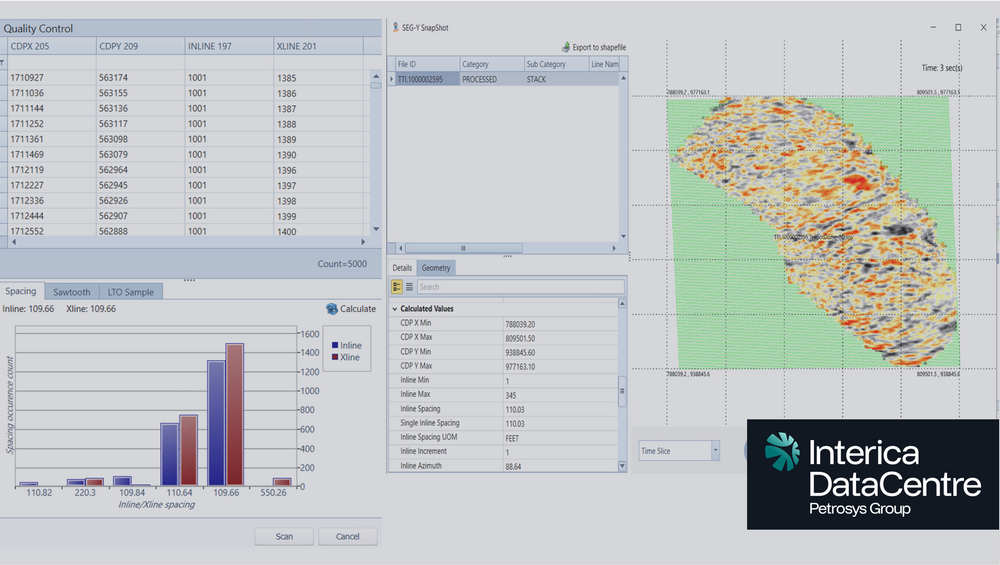
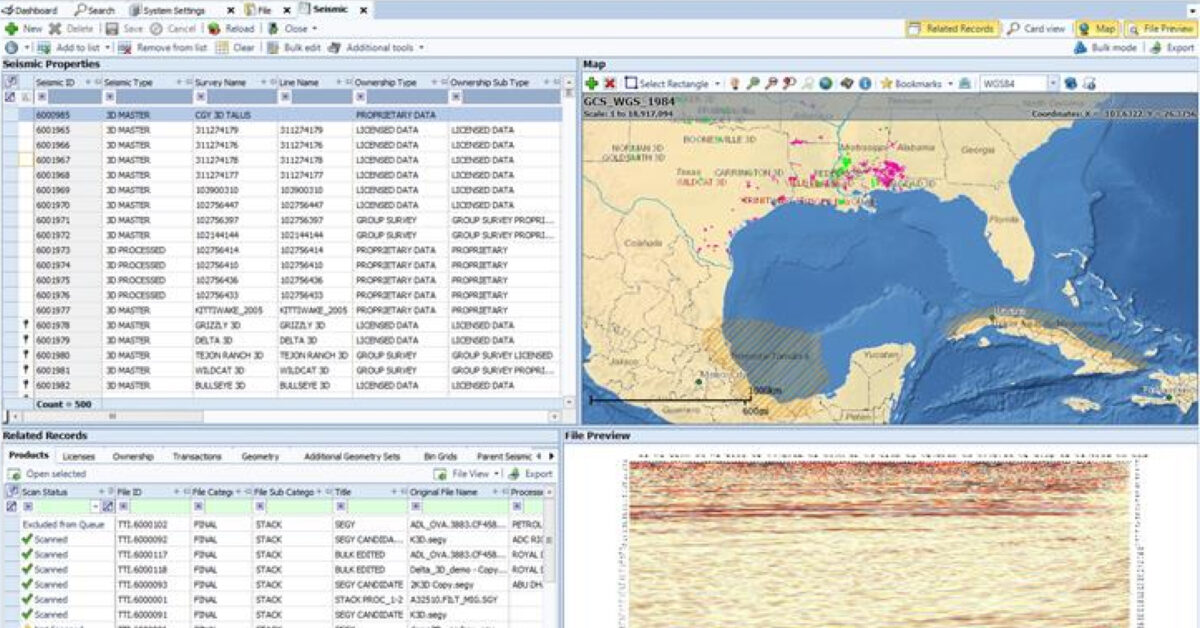
Interica DataCentre offers DMaaS, providing expert support for data QC, cataloging, and classification. Using Exploration Archives, we deliver a complete, searchable catalog of all datasets, ensuring governance and accessibility without increasing headcount. The DMaaS solution can be deployed in a variety of ways to suit the needs of the organization.

Impact:

Operators regain control over their data without the need to hire additional staff. By leveraging Interica DataCentre’s DMaaS and Exploration Archives, organizations achieve consistent data quality, improved governance, and faster access to critical datasets. This reduces operational risk, accelerates decision-making, and ensures long-term compliance with industry standards.

Complex Regulatory Submissions

Challenge:

Submitting data to the North Sea Transition Authority (NSTA) was time-consuming and prone to errors. Operators faced deadlines and lacked automated workflows, increasing compliance risk and resource strain.

Solution:

Interica DataCentre streamlined the entire submission process. We automated validation, standardized formats, and managed secure transfers to the NSTA, ensuring accuracy and compliance without manual intervention.

Impact:

Submission time dropped, and the client maintained full regulatory compliance without diverting internal resources.

Accelerating Data-Driven Insights – From Chaos to Clarity

Challenge

A global energy company was struggling to make timely decisions because project data was fragmented across Petrel, Techlog, OpenWorks, and network drives. Retrieving the right seismic or well dataset for analysis could take days, delaying evaluations and inflating project costs. These inefficiencies limited collaboration and obscured the true value of the organisation’s data assets.

Solution

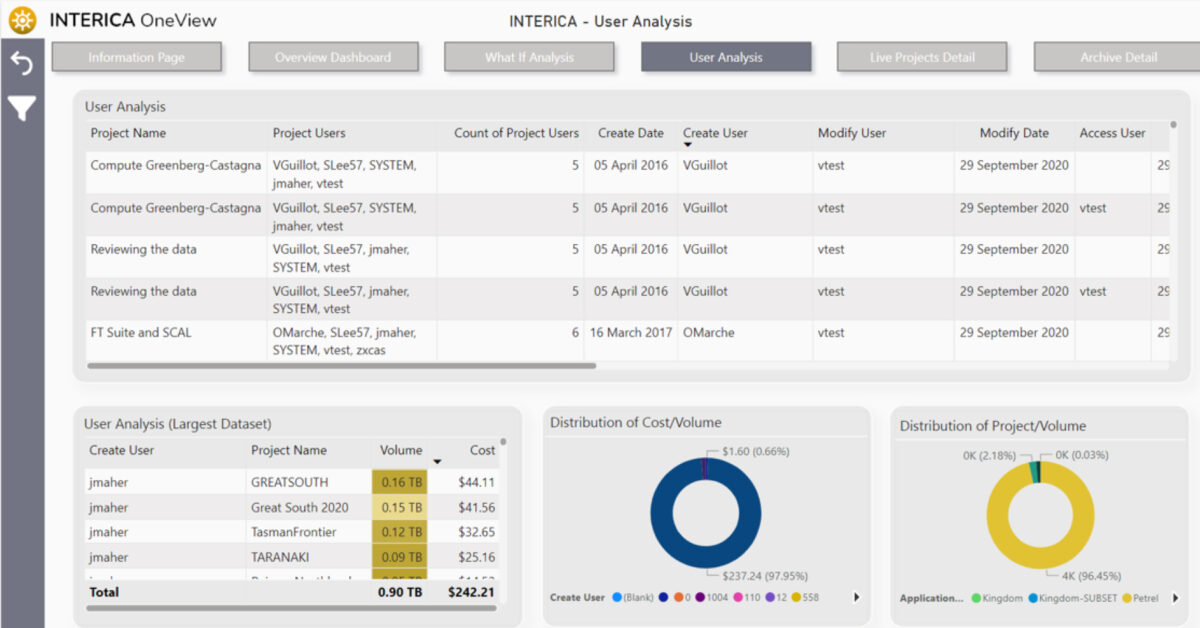
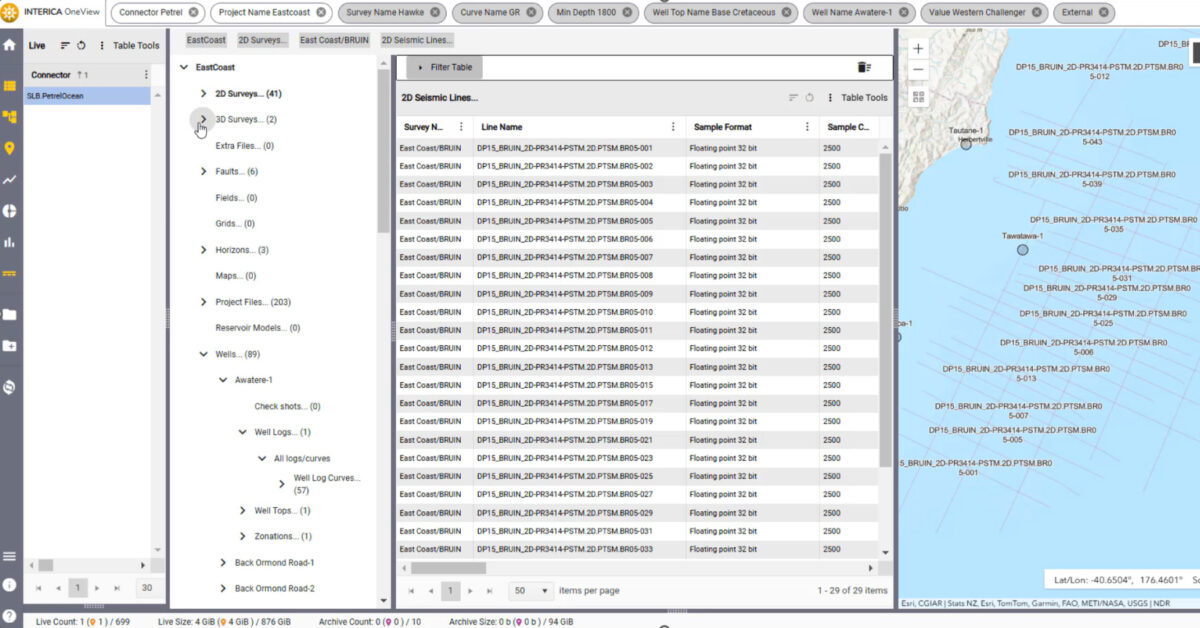
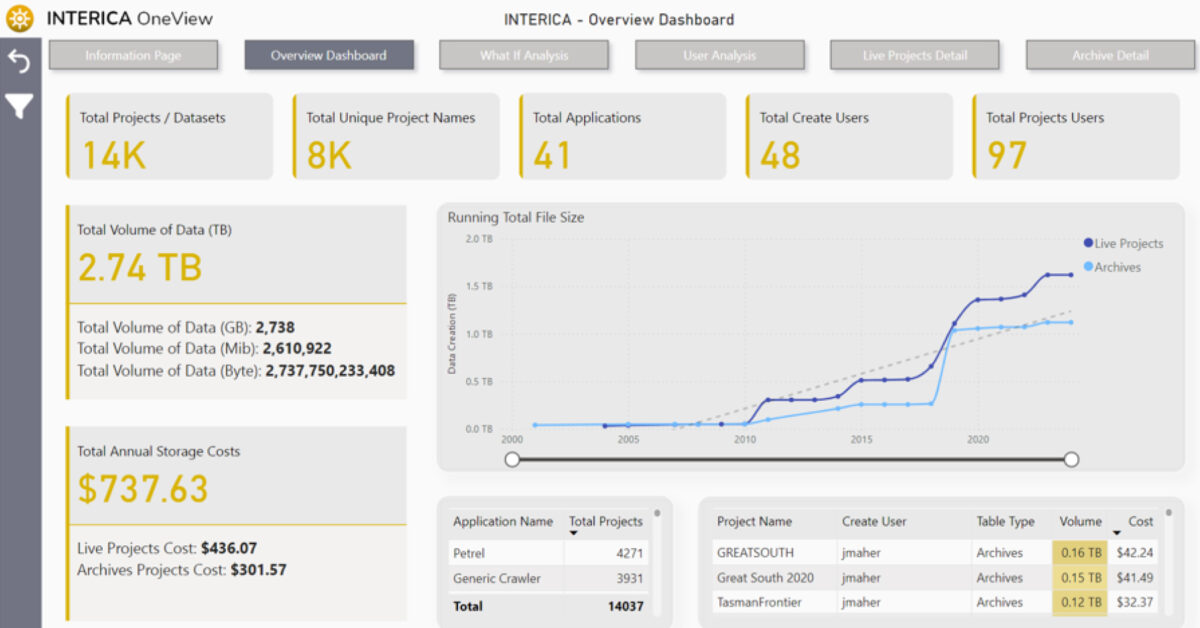
Interica OneView (IOV) centralised the discovery, classification, and visualisation of all subsurface information. Its intelligent connectors rapidly scanned and indexed seismic, well, and project data across applications, building a single, searchable catalogue. Integration with Power BI and Microsoft Fabric connected IOV’s curated metadata directly into enterprise analytics, enabling dynamic dashboards that revealed data age, usage patterns, and project health at a glance.

Result

With complete visibility of their data landscape, teams reduced search times by over 80%, improved collaboration between disciplines, and delivered faster technical evaluations. Real-time Power BI dashboards provided portfolio-level insight that guided reprocessing priorities and informed management decisions. The company achieved faster time-to-insight, higher data trust, and more efficient exploration planning.

Unlocking the Value of Dark Data

Challenge

Across decades of projects, energy companies have accumulated terabytes of subsurface information stored across disconnected file systems, project archives, and proprietary databases. The majority of this “dark data” — seismic volumes, application project files, reports, and supporting documents — remains invisible, unorganised, and unused.

Without clear metadata or indexing, valuable information is buried. The result?

  • Costly storage bills for data no one is using.
  • Compliance and security risks from forgotten, unclassified files.
  • Missed opportunities to learn from historical data and optimise decisions.

Solution

Interica OneView (IOV) brings visibility to the unseen.

Its intelligent connectors automatically scan and index seismic and project data, no matter where it lives — on-premise, in archives, or across the cloud. Once indexed, IOV’s rich metadata tagging and map-based interface make dark data instantly searchable and discoverable.

Through integration with Power BI and ArcGIS, users can visualise the size, age, and location of data assets, quickly identifying redundant projects, outdated files, or high-value information worth retaining.

Result

Within weeks, the organisation had a clear picture of its entire data estate — revealing that more than half of its stored data had been inactive for years. Using IOV’s automated classification, they could:

  • Retire or archive redundant datasets to lower-cost storage.
  • Secure sensitive or legacy files for compliance.
  • Uncover valuable insights from historical data that improved ongoing exploration and CCS projects.

What was once a hidden cost became an active asset. By turning dark data into actionable intelligence, Interica OneView helped the company reduce storage waste, improve governance, and unlock new knowledge from decades of subsurface history.

Optimising Data Storage Costs with Interica OneView

Challenge

A mid-size energy company faced an escalating storage crisis. Over time, its subsurface and project data had grown to nearly 5 petabytes, spread across Windows and Linux environments and multiple applications. Annual storage management costs exceeded $7.5 million, and the sheer volume of data was blocking its cloud migration plans. Duplicate datasets, inactive project files, and unstructured archives inflated infrastructure costs and slowed performance.

Solution

The company deployed Interica OneView (IOV) to gain full visibility and control of its data estate. IOV rapidly scanned and indexed data across both operating systems, identifying redundant and inactive files across seismic and application domains. Using policy-based archiving, the team safely migrated 3 petabytes of data to low-cost AWS cold storage, while retaining full traceability and metadata visibility through Power BI dashboards. Asset teams could still search, locate, and request archived data through IOV’s intuitive interface, maintaining accessibility without high active storage costs.

Result

Within the first year, the organisation achieved dramatic improvements in both cost and efficiency:

  • Storage footprint reduced by 60% through duplicate detection and archiving.
  • Annual savings of over $4 million, including avoided costs from future growth.
  • Successful cloud migration achieved with minimal disruption.
  • Improved data accessibility via Power BI integration and structured metadata. IOV’s automated discovery and archiving workflows helped transform the company’s sprawling data environment into a manageable, cost-efficient system — proving that visibility and governance directly drive financial performance.