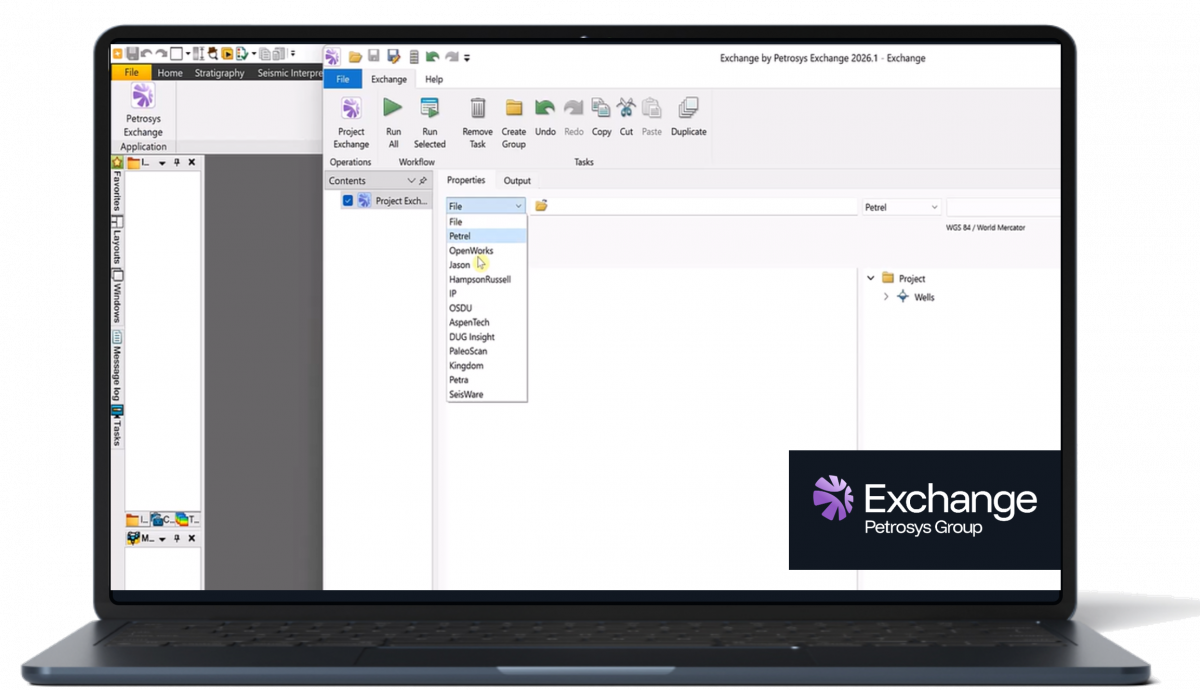
Reliable data exchange between Petrel and OpenWorks

A practical webinar on reliable data exchange between Petrel and OpenWorks.

Many subsurface teams work across multiple interpretation platforms, making it difficult to keep well and seismic data aligned between systems. Where Petrel and OpenWorks both play a role in the interpretation environment, maintaining consistent datasets can become time-consuming and difficult to manage through manual processes alone.

This webinar on demand shows how Exchange by Petrosys Group supports reliable well and seismic data exchange between Petrel and OpenWorks, helping teams maintain trusted datasets across interpretation workflows.

The session also demonstrates how Exchange provides a modern, actively developed alternative to legacy OpenSpirit-based workflows, supporting organisations that need dependable data flow between key interpretation platforms.

Complete the form to access the webinar on demand in both English and Spanish.

What this webinar covers

  • Well and seismic data exchange between Petrel and OpenWorks
  • A practical workflow demonstration using Exchange by Petrosys Group
  • How Exchange can replace or enhance legacy OpenSpirit-based workflows
  • How consistent data exchange supports interpretation teams working across multiple systems

Why watch

If your teams work across both Petrel and OpenWorks, this session provides a practical look at how Exchange helps reduce manual effort, improve consistency, and support trusted interpretation workflows across platforms.

It is also relevant for organisations reviewing their current OpenSpirit-based workflows and looking for a modern, supported approach to subsurface data exchange.

Access the On-Demand Webinar

Complete the form to receive access to the webinar recordings in English and Spanish.

Accelerating Subsurface Data Discovery | Exploration Archives AI

The Challenge

A subsurface team needs to quickly locate seismic datasets, technical reports, and contract information for a new evaluation area.

The organisation’s archive contains thousands of files across multiple storage environments with inconsistent metadata, varying naming conventions, and limited searchable context. Locating trusted information requires significant manual effort and specialist knowledge.

As a result, teams spend valuable time searching, validating, and organising data before interpretation work can begin.

Improving Archive Discovery Workflows

Exploration Archives AI helps teams improve archive discovery and metadata enrichment by introducing AI-assisted capabilities directly into existing workflows.

Rather than replacing operational processes, the platform automates repetitive, high-volume tasks while keeping experts in control of review and decision-making.

Using Exploration Archives AI, the team can:

  • Ask questions in plain language to locate relevant content
  • Automatically classify incoming files
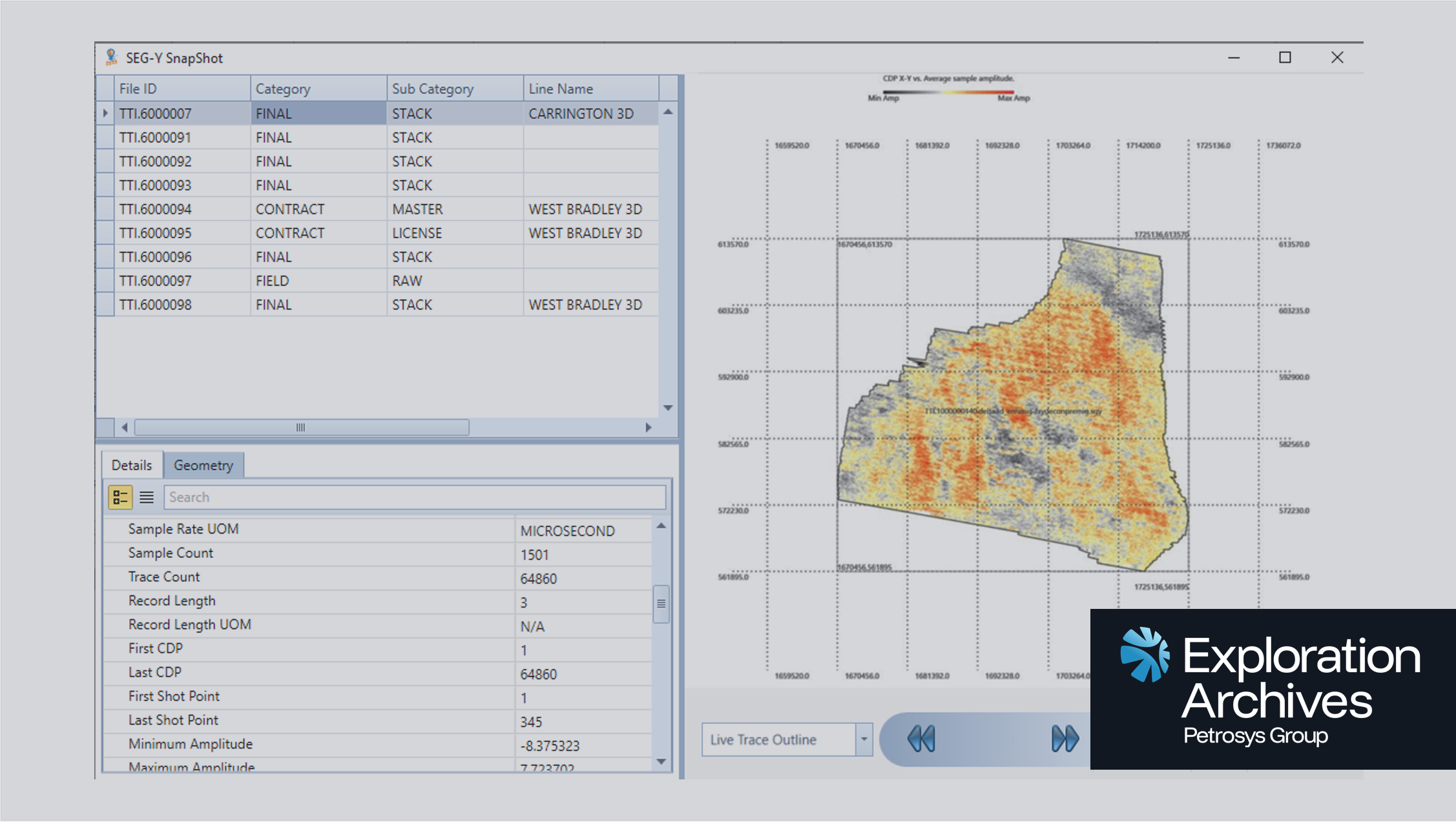
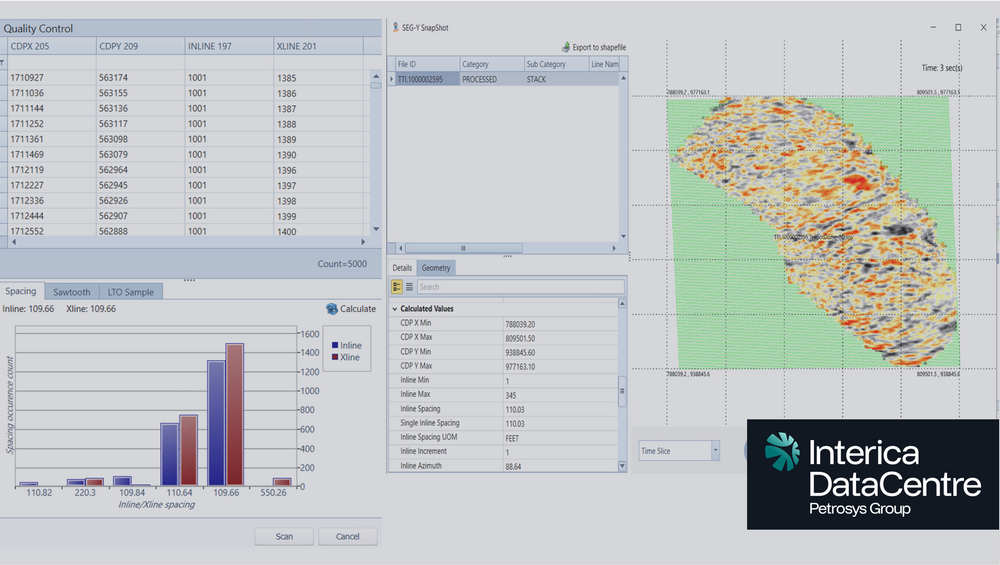
  • Scan SEG-Y datasets and extract metadata
  • Extract key details from contract documents into searchable fields

These capabilities help teams reduce manual effort while improving visibility and consistency across archive environments.

Key Capabilities Used

AI Archive Assistant

Search archive content and metadata using natural language questions to quickly locate relevant information across large archive environments.

Automated File Classification

Automatically classify files to improve metadata consistency and reduce manual tagging effort at scale.

SEG-Y Metadata Scanning & Classification

Scan SEG-Y datasets, extract metadata, and classify seismic files to improve searchability and archive visibility.

Contract Metadata Extraction

Extract key contract information into structured, searchable fields to improve accessibility and reduce manual document review effort.

Result

By combining archive discovery, metadata enrichment, and AI-assisted classification, the organisation improves how teams interact with existing archive environments.

Key outcomes include:

  • Faster access to trusted subsurface information
  • Reduced manual effort in archive workflows
  • Improved metadata consistency and searchability
  • Better reuse of existing archive content

Most importantly, these improvements are achieved without replacing existing workflows or compromising governance and expert oversight.


Explore Exploration Archives AI

Learn how Exploration Archives AI can support archive discovery, metadata enrichment, and operational workflow efficiency across subsurface data environments.

Eliminating Data Conflicts After an Asset Acquisition

Challenge:

A mid-size operator acquired several offshore assets, inheriting decades of well and seismic data, split across Petrel projects, spreadsheets, network drives, and physical media. Different business units used different naming conventions, coordinate systems, and versions of the same wells.

Teams lacked a single source of truth, slowing subsurface evaluations and delaying integration with corporate systems.

Solution:

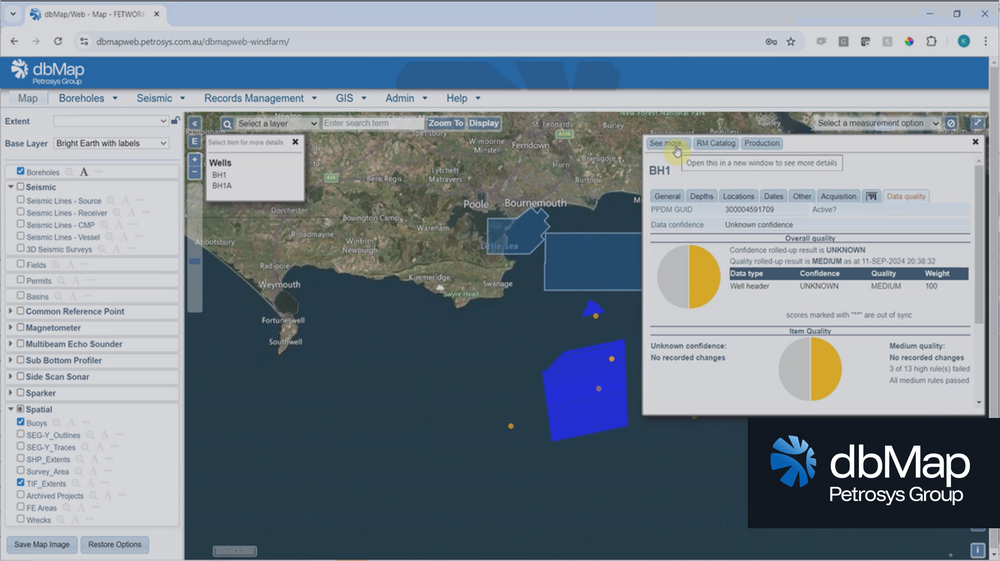
dbMap ingested the acquired datasets and aligned them to a PPDM-compliant corporate master, consolidating:

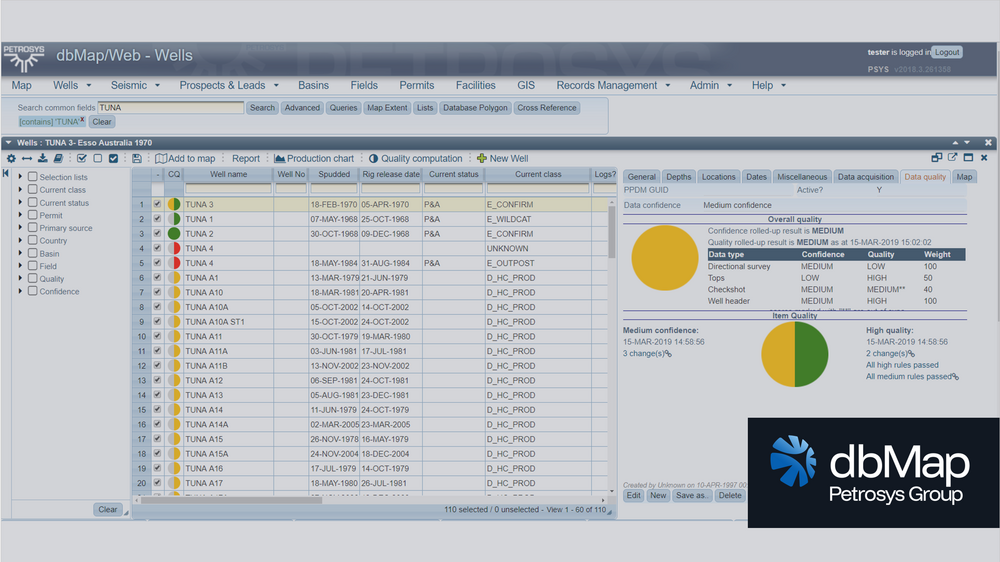
  • well headers, directional surveys, logs, tops and cores
  • 2D and 3D seismic index information
  • leases, permits, basins and fields
  • associated unstructured records through Records Management

Automated governance rules flagged mismatches, duplicates and missing metadata. Review workflows enabled data managers to validate updates before promoting them to the corporate master database.

Result: Eliminating Data Conflicts

  • A unified subsurface reference dataset used across the organisation
  • Faster screening of newly acquired blocks with trusted, consistent data
  • Reduced rework as all teams accessed authoritative well and seismic information
  • Clear audit history supporting regulatory and stakeholder reporting

Managing Seismic Contracts During Regional Divestments

Scenario

Operators routinely divest entire regional seismic libraries, such as selling all North Sea assets to another operator. Effective seismic contract management is critical during these, often billion-dollar transactions, where proprietary rights, entitlements, merged surveys, and physical media boundaries all determine what data can legally be transferred.

Challenge – Managing Seismic Contracts

Data management teams must confidently identify exactly what data is included in the divestment. Questions arise quickly:

  • Which surveys are proprietary vs. non-proprietary?
  • Do any merged or reprocessed surveys contain mixed entitlements?
  • Does physical media contain data both inside and outside the region?
  • Are legal constraints tied to specific vintages, partners, or acquisition types?

Without accurate contract and entitlement tracking, operators risk transferring the wrong data, or worse, sending non-entitled data and facing legal exposure.

Solution

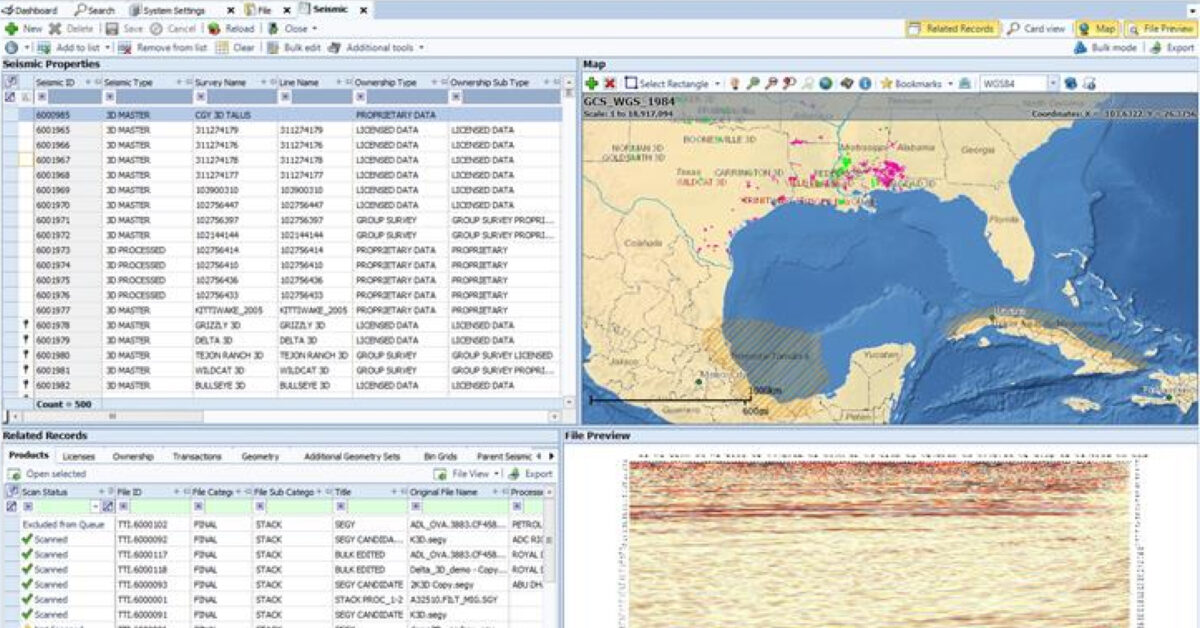
Exploration Archives centralises the management of seismic contracts, entitlements, and ownership. It automatically highlights surveys with mixed rights, flags datasets requiring legal review, and identifies media that must be split before transfer. EA’s data request workflows guide data managers through physically retrieving, validating, and preparing media for third-party delivery, ensuring nothing is overlooked.

Impact

What once took years now takes weeks.
Data management teams can deliver complete, validated seismic packages with full entitlement control, significantly reducing operational and legal risk. EA ensures operators only transfer the correct, owned data, protecting both revenue and compliance.

Managing Legacy Seismic Media at Scale

Challenge

Many large operators continue to rely on physical tapes to store decades of legacy seismic media, often in regions considered “low interest” at the time of acquisition. As technology improves, geophysicists revisit these historic datasets to unlock new insight, but without proper governance, locating the correct tapes across hundreds of thousands of media items becomes nearly impossible. Assets may be spread across warehouses, stored off-site, mislabelled, or, in many cases, sitting in forgotten boxes under desks. This leads to months of delay, uncertainty, and the real risk of losing high-value seismic.

Solution

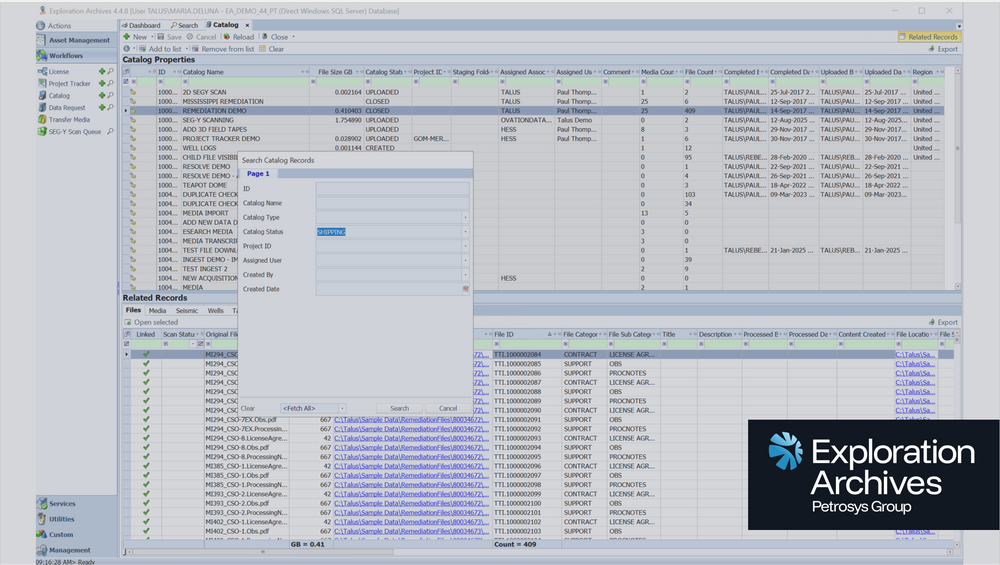
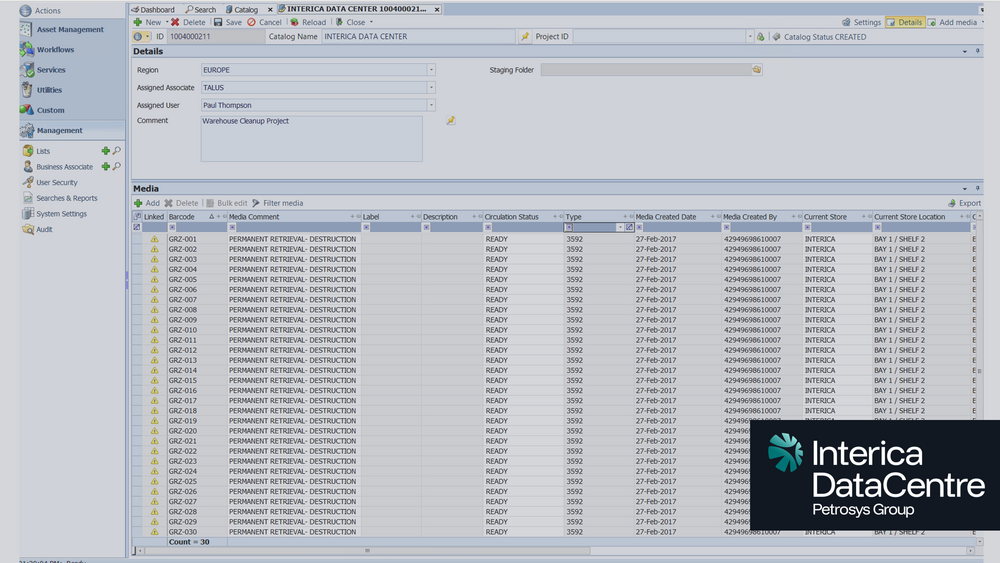
Exploration Archives scans, catalogues, and classifies both physical and digital seismic assets, giving organisations complete visibility of their media estate. Operators can quickly see where legacy tapes are stored, how they are organised, and whether metadata is valid. EA’s workflow and warehouse management tools help teams remediate high-interest areas, correct inaccurate data, and prepare physical media for reprocessing or digitisation. If an area becomes active again, EA provides a governed, repeatable workflow to ensure media is located, validated, and prepared quickly and accurately.

Primary Impact

Operators who previously spent months searching for tapes now locate all required media in minutes. With EA, seismic stored across multiple warehouses, boxes, and legacy systems becomes instantly discoverable and reportable.

Additional Impact

Remediation frequently uncovers previously unrecorded or missing seismic, a multi-million-dollar asset that would have remained lost without proper visibility. EA ensures legacy seismic is no longer a liability, but an asset ready to support new exploration

Establishing Corporate Data Governance for a Multi-Disciplinary Energy Team

Challenge:

An integrated energy company (oil, gas, geothermal and CCS) struggled with siloed technical data spread across Petrel, Landmark, GIS, SharePoint and various vendor systems.

Different departments stored “their own” version of well and seismic data, making cross-disciplinary workflows inconsistent and exposing the company to regulatory and operational risk.

Solution:

dbMap was deployed as the organisation’s enterprise subsurface master data environment, standardising corporate data governance across all teams.

Using dbMap, they:

  • Centralised wells, surveys, tops, logs, cores, 2D/3D seismic and leases
  • Harmonised data using PPDM standards
  • Implemented version control and audit trails for all updates
  • Used Records Management to catalogue associated reports, log scans and physical media
  • Connected dbMap to Petrel and Landmark via Exchange for controlled data flow into interpretation environments

Result:

  • Consistent, trusted subsurface data feeding every technical workflow
  • Data quality improved through controlled promotion workflows and metadata checks
  • Faster cross-disciplinary collaboration (geology, geophysics, GIS, subsurface engineering)
  • Stronger compliance position with regulators through transparent lineage and auditable processes

Disaster Recovery for a Major Middle East Operator

Challenge:

One of the largest oil and gas operators in the Middle East needed a secure disaster recovery solution to protect Petro technical data and maintain operational continuity. With thousands of legacy tapes and critical interpretation datasets at stake, any downtime could impact multi-billion-dollar projects.

Solution:

Interica DataCentre manages all disaster recovery media handling and storage for the client. Using Exploration Archives, we catalog and index every dataset, providing complete visibility and rapid retrieval. Our isolated DR environment ensures high availability and compliance with corporate resilience standards.

Impact:

The client achieved uninterrupted access to critical data, reduced downtime risk, and secured decades of subsurface information for long-term business continuity.

Data Management as a Service for Subsurface Data Teams

Challenge:

Many operators are experiencing a steady loss of experienced subsurface data managers due to retirements, restructuring, and shifting organisational priorities. As this expertise leaves the business, critical knowledge about data standards, legacy formats, physical media, and historical datasets is often lost with it.

At the same time, remaining teams are under pressure to manage growing volumes of digital and physical subsurface data with fewer resources. This creates gaps in quality control, inconsistent cataloguing practices, and increased reliance on spreadsheets or ad-hoc processes. Over time, data becomes harder to find, trust, and govern – increasing operational risk and slowing response to internal and regulatory requests.

Solution:

Interica DataCentre offers DMaaS, providing expert support for data QC, cataloging, and classification. Using Exploration Archives, we deliver a complete, searchable catalog of all datasets, ensuring governance and accessibility without increasing headcount. The DMaaS solution can be deployed in a variety of ways to suit the needs of the organization.

Impact:

Operators regain control over their data without the need to hire additional staff. By leveraging Interica DataCentre’s DMaaS and Exploration Archives, organizations achieve consistent data quality, improved governance, and faster access to critical datasets. This reduces operational risk, accelerates decision-making, and ensures long-term compliance with industry standards.

Complex Regulatory Submissions

Challenge:

Submitting data to the North Sea Transition Authority (NSTA) was time-consuming and prone to errors. Operators faced deadlines and lacked automated workflows, increasing compliance risk and resource strain.

Solution:

Interica DataCentre streamlined the entire submission process. We automated validation, standardized formats, and managed secure transfers to the NSTA, ensuring accuracy and compliance without manual intervention.

Impact:

Submission time dropped, and the client maintained full regulatory compliance without diverting internal resources.

Accelerating Data-Driven Insights – From Chaos to Clarity

Challenge

A global energy company was struggling to make timely decisions because project data was fragmented across Petrel, Techlog, OpenWorks, and network drives. Retrieving the right seismic or well dataset for analysis could take days, delaying evaluations and inflating project costs. These inefficiencies limited collaboration and obscured the true value of the organisation’s data assets.

Solution

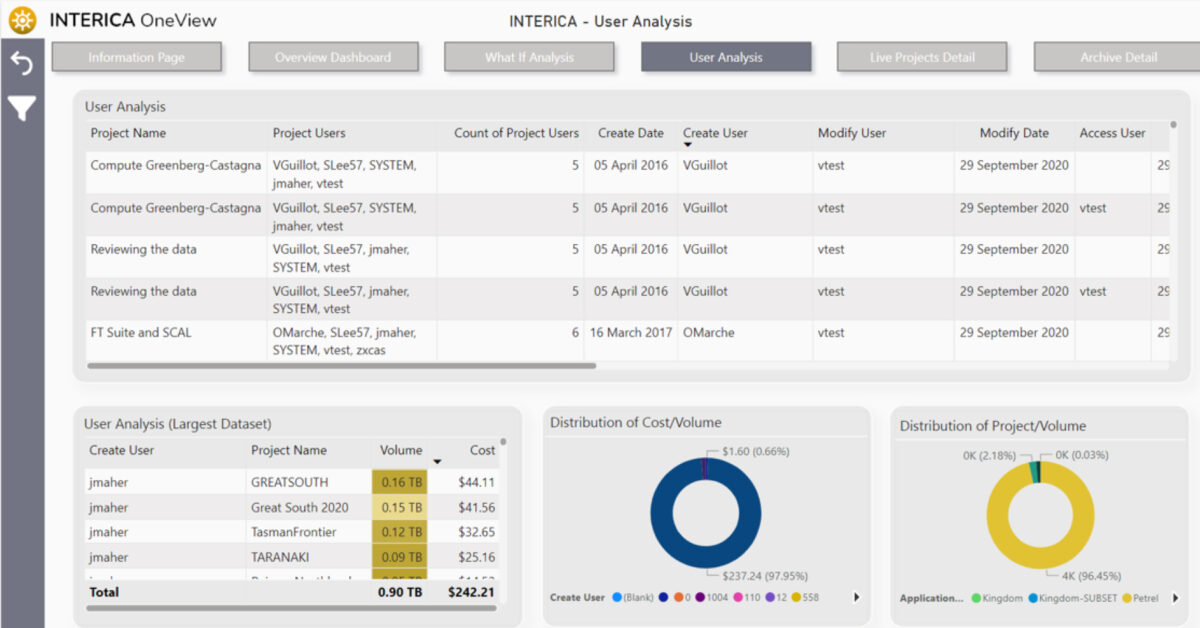
Interica OneView (IOV) centralised the discovery, classification, and visualisation of all subsurface information. Its intelligent connectors rapidly scanned and indexed seismic, well, and project data across applications, building a single, searchable catalogue. Integration with Power BI and Microsoft Fabric connected IOV’s curated metadata directly into enterprise analytics, enabling dynamic dashboards that revealed data age, usage patterns, and project health at a glance.

Result: Accelerating Data-Driven Insights

With complete visibility of their data landscape, teams reduced search times by over 80%, improved collaboration between disciplines, and delivered faster technical evaluations. Real-time Power BI dashboards provided portfolio-level insight that guided reprocessing priorities and informed management decisions. The company achieved faster time-to-insight, higher data trust, and more efficient exploration planning.